
County leaders across Maryland called for more local revenue options while delivering an equally clear message: a new authority cannot become another way to shift state costs onto county budgets.
The Task Force to Modernize County and Municipal Revenue Structures held a public hearing on September 14, giving county executives, council members, commissioners, and fiscal leaders a chance to weigh in as the panel develops recommendations ahead of the 2027 legislative session. The General Assembly created the Task Force to study and evaluate county and municipal revenue structures across Maryland.
MACo has long advocated for local revenue flexibility that recognizes the different economies, tax bases, service demands, and fiscal pressures across Maryland’s counties. The hearing also brought another issue to the forefront, as county leaders repeatedly warned that additional revenue authority cannot substitute for the State meeting its existing funding responsibilities.

Testimony from large and small counties across Maryland’s urban, suburban, and rural communities reflected those differences while offering examples of how additional tools could work locally and how State cost shifts continue to strain county budgets.
Montgomery County Executive Marc Elrich called for differential property tax authority and more flexibility in local income taxes. He also urged the Task Force to consider State-to-county cost shifts as it evaluates whether counties have adequate tools to meet their responsibilities.
Anne Arundel County Executive Steuart Pittman pointed to the State’s previous authorization of local income tax brackets as an example of how local flexibility can work. Anne Arundel County used that authority to lower taxes on income below $50,000 before increasing the rate for the top 2% of earners.
Montgomery County Council Member Will Jawando similarly called for revenue tools that recognize differences among county economies, tax bases, and service demands. Council Member Kristin Mink highlighted growing education costs and federal actions putting additional pressure on local budgets, while discussing income tax flexibility as a way to support lower-income residents.
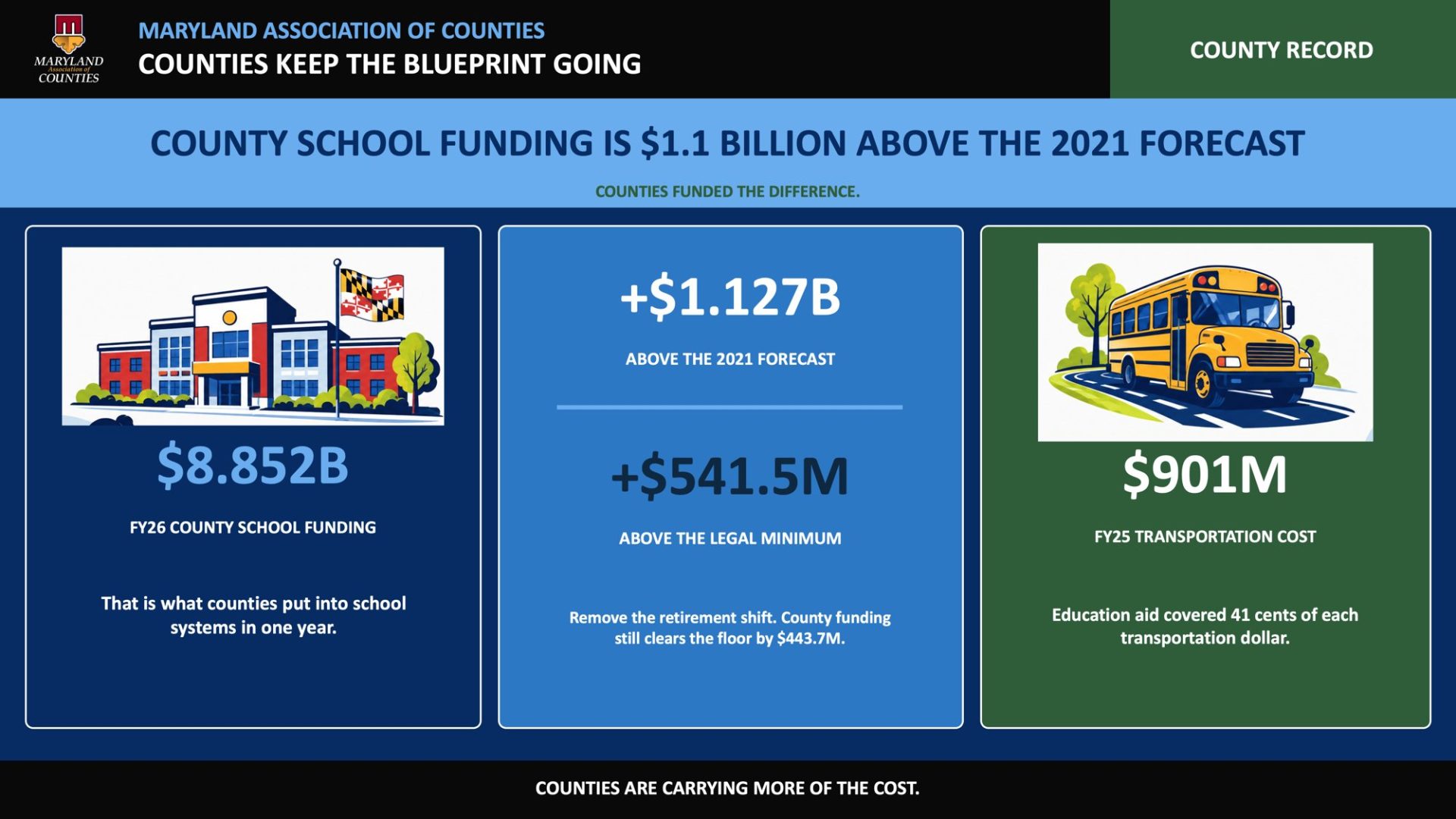
Dorchester County leaders focused on the pressures facing smaller counties. County Council President and MACo First Vice President Lenny Pfeffer said Dorchester has already raised both its income and property taxes to pay for rising State mandates, while Council Vice President Mike Detmer warned that “modest changes can’t keep pace with massive obligations.”
Harford County Treasurer and MACo Budget and Finance Affiliate President Robbie Sandlass highlighted State cost shifts, revenue volatility, and the need to put counties on equal footing when it comes to revenue authority. Sandlass said recent cost shifts amount to roughly $10 million annually for Harford County, equivalent to about 2.5 cents on its property tax rate, even before Blueprint mandates or Highway User Revenue cuts.
Prince George’s County Council Member Jolene Ivey pointed to pension cost shifts and corresponding grant reductions putting additional pressure on county budgets. She also discussed the County’s interest in providing property tax relief for seniors and the need for more options to make that possible.
Charles County Fiscal and Administrative Services Director Jake Dyer connected the discussion to housing affordability and counties’ heavy reliance on property taxes. Dyer emphasized the need for options that reduce pressure on property taxes while counties continue funding essential services.
Howard County Budget Administrator Holly Sun pointed to slowing revenue growth alongside growing education, infrastructure, employee benefit, and State-imposed costs. Sun emphasized that new revenue tools should help counties address local fiscal challenges, “NOT to fund more state cost shifts!”
Frederick County Chief Financial Officer Daniel Lewis said Frederick absorbed more than $12 million in additional local responsibilities across fiscal 2026 and fiscal 2027 without corresponding enhancements to its revenue authority. Lewis highlighted several potential tools, including authority to differentiate commercial and industrial property tax rates and address data center business personal property.
Baltimore City leaders also outlined several of its fiscal needs. Mayor Brandon Scott called for local sales tax authority, noting that 89% of US cities with populations over 200,000 receive a local share of sales tax revenue.
Mayor Scott also stressed the importance of Highway User Revenues, noting that Baltimore City maintains 2,000 miles of roadways, seven miles of interstate, all its bridges, streetlights, and intersections. He urged policymakers to protect and restore Baltimore City’s transportation funding.
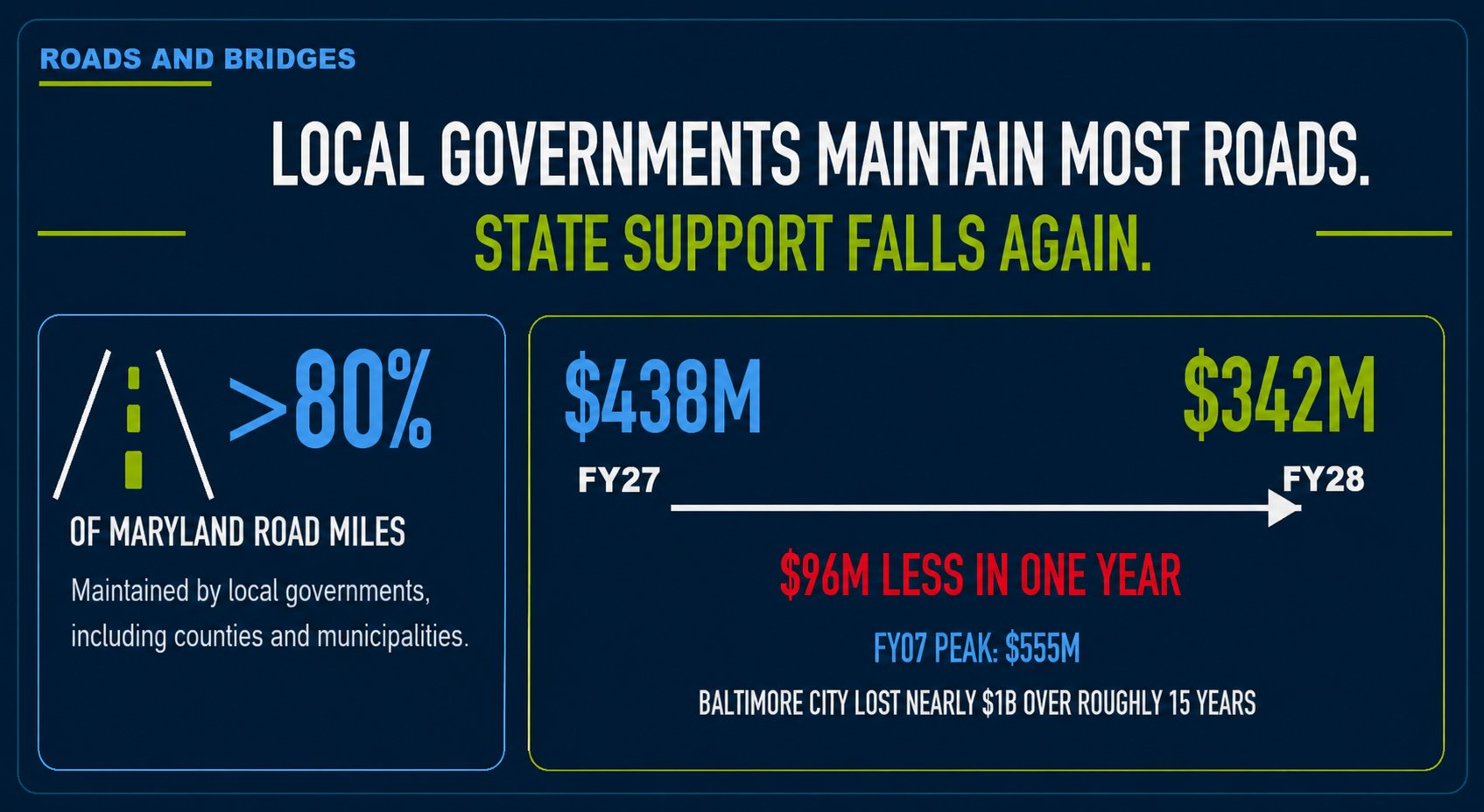
Baltimore City Council Member Odette Ramos called for maximum local revenue flexibility to help fund growing responsibilities, including the Blueprint for Maryland’s Future.
Written testimony submitted to the Task Force added perspectives from several other counties.
Carroll County cautioned against a one-size-fits-all approach, noting that a revenue mechanism that works in a large, commercially dense jurisdiction may offer little benefit elsewhere. The County urged the Task Force to pair workable local tools with protection against additional State cost shifts.
Cecil County Executive Adam Streight argued that counties increasingly face a “cost-shift problem” as the State transfers additional responsibilities and expenses to local budgets. He urged the Task Force to distinguish between giving counties more flexibility and expecting counties to raise taxes to cover State obligations.
Talbot County Finance Director Martha Darling Sparks emphasized the differences among Maryland’s rural, urban, and suburban counties. She called for additional local options while warning that “revenue flexibility should strengthen local government and not substitute for state funding obligations.”
Baltimore County Chief of Budget and Administration Elizabeth Lea Miller Paulov offered a different perspective, noting that Baltimore County implemented substantial revenue changes in 2020 and does not currently seek major changes to its revenue authority. Instead, the County emphasized growing pressure from the Blueprint for Maryland’s Future, Time to Care, pension-related cost shifts, and potential reductions in State aid.
Baltimore City Council Member Zac Blanchard’s written testimony highlighted land value taxation as another potential option for the Task Force to consider.
The General Assembly created the Task Force through HB 1142 during the 2026 legislative session, charging it with studying and evaluating county and municipal revenue structures and reporting its findings and recommendations by December 1.
MACo representatives Christiana Rigby, Council Member for Howard County, and Rich Madaleno, Chief Administrative Officer for Montgomery County, serve on the Task Force. State law reserves two seats on the panel for MACo representatives.
As the Task Force develops its recommendations ahead of the 2027 legislative session, MACo will continue advocating for meaningful local options while emphasizing that new authority should not finance additional State cost shifts.
The Task Force webpage includes the hearing video and submitted written testimony.
Stay tuned to Conduit Street for more information.
