
Maryland’s Task Force to Modernize County and Municipal Revenue Structures focused its October 2 meeting on rising school facility costs and several potential new revenue options for local governments.
School construction and maintenance costs dominated the first part of the meeting. IAC outlined nearly $2 billion in annual unmet needs for school maintenance, operations, and capital renewal, along with a separate $1.3 billion gap in State school construction funding over the past two decades.
The Task Force also reviewed retail delivery fees, a local meals tax, municipal hotel taxes, and special property tax rates. Members asked for additional information on county-municipal revenue sharing, revenue structures in other states, and data center revenues.
School Facilities Face Growing Costs and Funding Gaps
Interagency Commission on School Construction Executive Director Alex Donahue outlined the costs of maintaining Maryland’s 1,350 public school facilities, with an estimated replacement value of about $75 billion. IAC estimates an annual FY 2026 funding gap of $1 billion for maintenance and operations, plus $940 million for capital renewal.
That combined $1.94 billion estimate excludes pre-K expansion, decarbonization, and some other needs.

Counties already cover most school construction costs. Donahue said counties have accounted for roughly two-thirds of school capital spending over the past two decades.
IAC also compared State school construction appropriations with a cost-adjusted funding target from fiscal 2004 through fiscal 2027. The cumulative gap over that period is about $1.3 billion.

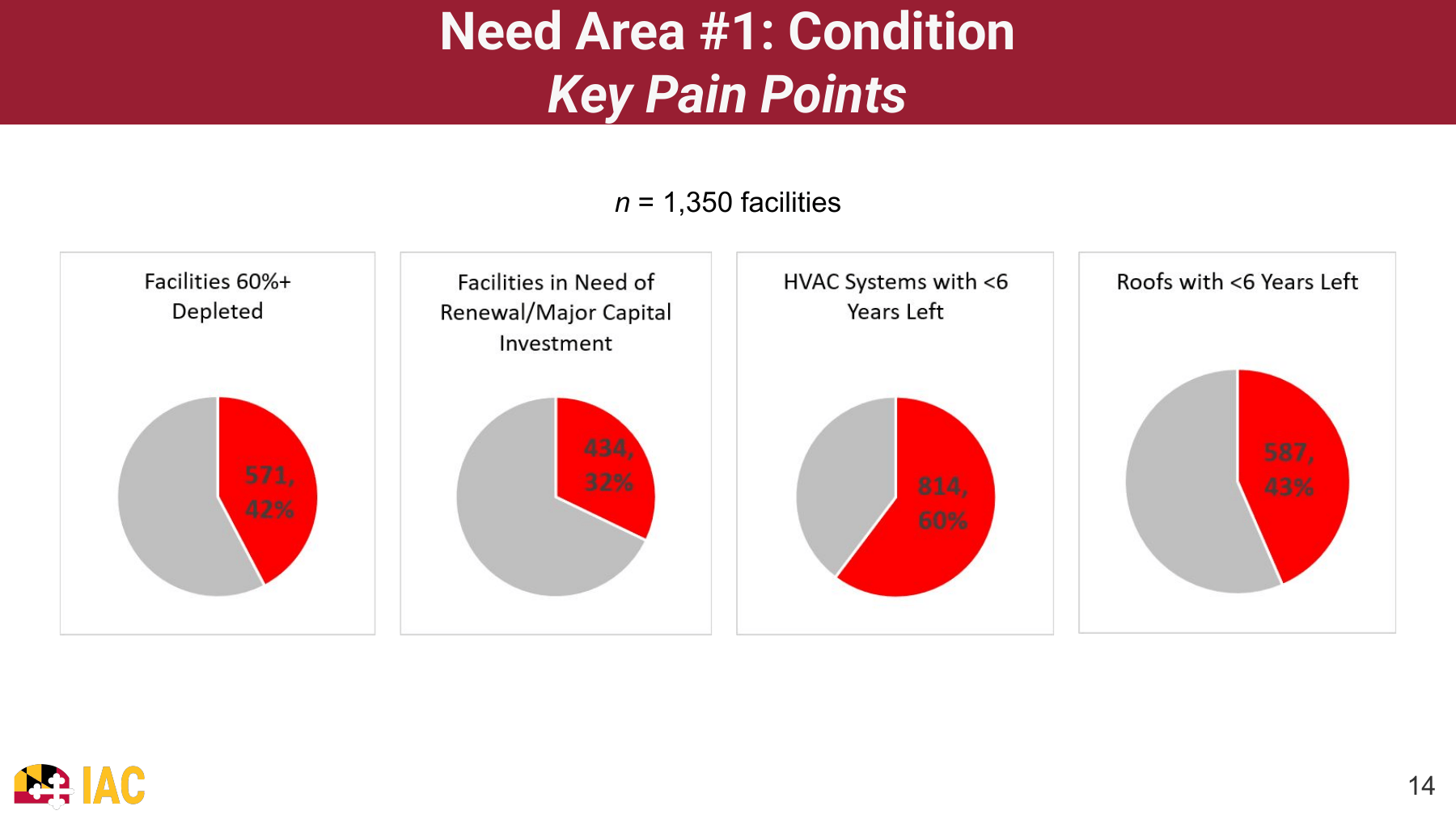
School construction costs have risen much faster than inflation. IAC reported a 210% increase in construction costs from 2003 to 2026, compared with 82% growth in US consumer prices. At the same time, 42% of Maryland school facilities have used at least 60% of their expected useful life.
IAC identified 434 facilities needing renewal or major capital investment, 814 HVAC systems with fewer than six years remaining, and 587 roofs with fewer than six years remaining. Donahue stressed that delayed investment can increase maintenance costs and make facilities less reliable.
The discussion also addressed counties’ role in decisions that determine school costs. Members raised concerns about funding obligations without corresponding control over educational requirements and building plans, as well as the difference between a stated State–local cost share and what counties ultimately pay after ineligible expenses.
Donahue pointed to a recent agreement among IAC, Worcester County, and the school system for two school replacement projects. The agreement lays out the project order, size and cost limits, and how much each side will contribute.
National Comparisons Show Different Revenue Choices
Jonathan Harris, research director at the National Association of Counties, presented national data illustrating the differences in county responsibilities and revenue structures. Maryland’s reliance on local income taxes distinguishes it from many states where counties depend more heavily on property taxes, sales taxes, or charges.
Harris compared Maryland with North Carolina, Tennessee, and Virginia, where counties also fund K–12 education. Those comparisons illustrated different combinations of locally generated revenue and State support, underscoring the importance of considering service obligations alongside tax collections.

Members sought additional information on county–municipal revenue sharing, jurisdictions with access to both income and sales tax revenue, and revenue generated by data centers. Harris noted that the lag in federal fiscal data limits its ability to capture recent data center growth.
Retail Delivery Fee Raises Design and Collection Questions
Department of Legislative Services staff reviewed retail delivery fees in Colorado and Minnesota as potential models. Colorado’s fee is 31 cents for 2026–27, while Minnesota imposes a 50-cent fee on qualifying purchases of $100 or more, with business thresholds and product exemptions.
The presentation estimated that a local fee could generate approximately $200 million statewide at 50 cents or $300 million at 75 cents, assuming full local adoption. Those figures describe potential revenue under illustrative scenarios.

Members questioned whether purchase thresholds could encourage customers to split orders into smaller transactions, potentially increasing deliveries. Discussion also covered canceled orders, purchases containing both exempt and taxable items, and the burden on retailers that collect and remit the fee.
Both existing state models use statewide fees, and DLS identified uniformity as an administrative advantage. A local option would require clear rules for determining where the fee applies and how retailers handle different jurisdictions.
Meals Tax Returns to the Revenue Discussion
DLS also revisited a food and beverage tax proposal from the 2025 session. SB 324/HB 997 would have allowed counties and municipalities to impose a tax of up to 3% on specified food and beverage sales through the admissions and amusement tax structure.
The proposal was a Maryland Municipal League priority and also had support from MACo and Baltimore City. It did not advance during the 2025 session, but the concept remains part of the broader discussion around local revenue options.
The presentation estimated approximately $460 million in annual statewide revenue if every local government adopted the maximum rate. Staff also noted that using an existing tax structure could reduce startup and administrative costs.

The proposal would enter a difficult political environment if lawmakers revisit it in 2027. DLS flagged the regressive nature of flat consumption taxes and the sensitivity of restaurant spending during economic downturns, while opponents from the restaurant and hospitality industries argued last session that an added local tax would raise menu prices and further pressure businesses already dealing with higher labor and food costs.
Municipal Tax Options Remain Part of the Discussion
DLS outlined an option to expand municipal hotel-tax eligibility to municipalities in Carroll, Frederick, Washington, and Wicomico counties. The presentation also identified increasing the maximum municipal rate from 2% to 3% or more as a possible change.
A separate presentation examined municipal authority to impose different property tax rates on different classes of property. DLS reported that 13 Maryland municipalities use special rates, often for commercial property or apartments, and highlighted concerns about unequal treatment and potential costs to renters.
County Tax Rates Show Limited Movement
DLS also compared county tax rates from 2022 through 2027. Over that period, eight counties lowered their property tax rates, seven raised them, and nine left them unchanged.
In fiscal 2026, counties left an estimated $501.9 million on the table by setting homestead assessment caps below the 10% statutory maximum. For calendar 2027, only three counties impose the maximum 3.3% local income tax rate.
Other local tax rates changed relatively little. DLS reported only two increases in recordation tax rates, one change to a graduated transfer tax structure, no changes to admissions and amusement tax rates, and two increases in hotel tax rates between fiscal 2022 and fiscal 2027.
Task Force Heads Toward December Recommendations
The General Assembly created the Task Force through HB 1142 during the 2026 legislative session. The panel must study and evaluate county and municipal revenue structures and submit recommendations to the Governor and General Assembly by December 1.
Maryland Comptroller Brooke Lierman chairs the Task Force. Howard County Council Member Christiana Rigby and Montgomery County Chief Administrative Officer Rich Madaleno serve as MACo’s representatives, bringing county fiscal and service-delivery concerns directly into the Task Force’s work.
The October meeting builds on several months of work around local revenue flexibility.
As previously reported on Conduit Street, the Task Force’s August meeting examined existing local taxing authority, property tax options, and other approaches that could give counties and municipalities more flexibility. MACo has emphasized that new local revenue tools should expand county options, not shift costs or replace existing support.
County leaders reinforced that message during the Task Force’s September 14 public hearing, calling for broader revenue authority that reflects the different tax bases, service demands, and fiscal pressures across Maryland.
The Task Force has additional meetings scheduled for October 30 and November 30 before its December 1 reporting deadline.
Stay tuned to Conduit Street for more information.
More Information
