
Maryland’s planned roadway maintenance spending falls well short of identified needs, according to a new national analysis that underscores the continuing struggle to keep the transportation system in good repair.
The Pew Charitable Trusts analyzed states’ long-term roadway maintenance needs and found that Maryland identified approximately $5.9 billion in needs against $4.7 billion in planned spending, leaving a projected $1.17 billion gap. Maryland’s shortfall equals 25% of its planned expenditures, according to Pew.
Maryland is far from alone. Of the 33 states with enough data for Pew to make the comparison, 24 reported maintenance shortfalls, ranging from 2% of planned spending in Kansas to 173% in New York. Five states reported gaps larger than their entire planned maintenance budgets.
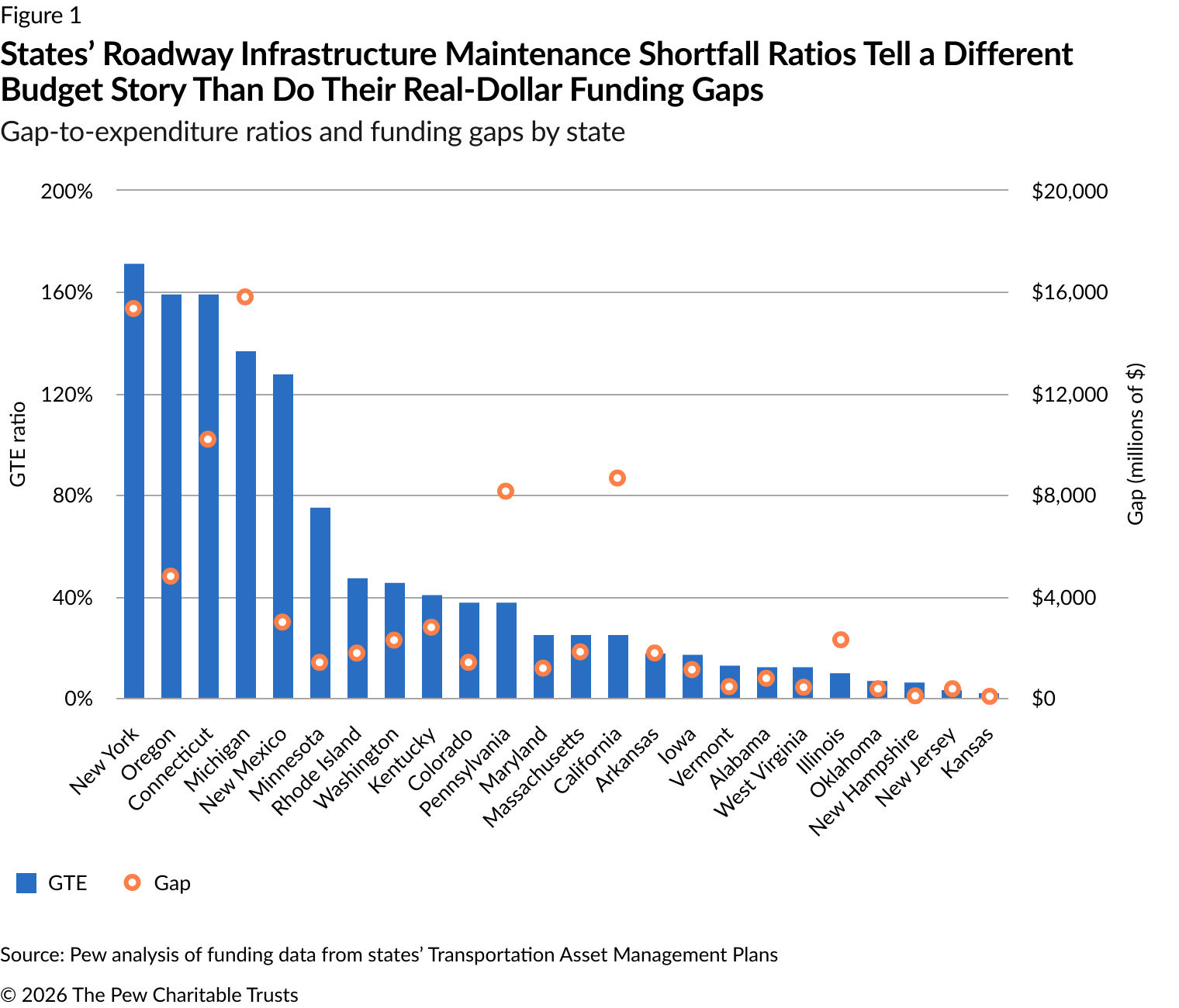
Pew’s percentage helps put those dollar gaps in context. Maryland, California, and Massachusetts each posted a 25% gap despite significantly different dollar shortfalls, showing that the scale of the maintenance challenge depends on the size of each state’s planned spending.
The analysis draws from states’ 2022 Transportation Asset Management Plans, so the Maryland figure does not reflect all transportation funding added since then. In recent years, the General Assembly approved more than $400 million annually in additional transportation revenues, allowing MDOT to leverage additional federal funding and stabilize its capital program.
But the underlying pressure Pew identifies has not disappeared. MDOT’s latest six-year Consolidated Transportation Program totals $22.1 billion for fiscal 2026 through fiscal 2031. MDOT continues to prioritize system preservation while acknowledging that rising construction costs, the cost of maintaining existing infrastructure, and growing operating expenses continue to strain the Transportation Trust Fund.
Inflation also puts the size of the capital program in perspective. MDOT’s latest Attainment Report shows that the $22.1 billion CTP remains below several recent six-year programs after adjusting those earlier plans for construction inflation.

That pressure reaches directly to county governments. Maryland’s transportation system depends on a state-local funding partnership, with Highway User Revenues providing counties, municipalities, and Baltimore City with a share of transportation revenues for local roads and bridges.
And another funding challenge is approaching. Under the current funding schedule, Highway User Revenues fall from $438 million in fiscal 2027 to $342 million in fiscal 2028, a nearly $100 million reduction in local transportation funding in just one year.

That drop comes as counties already face higher costs for resurfacing, bridge maintenance, drainage, and other basic infrastructure work. Unlike many capital projects, governments cannot indefinitely postpone maintenance without risking more expensive repairs later, a problem Pew specifically identifies when states allow maintenance backlogs to grow.
Maryland has taken steps to increase transportation funding, and the additional funding has helped MDOT preserve projects and increase investment in system maintenance. Pew’s analysis shows that significant maintenance needs remain, even with those additional resources.
That challenge will remain central as Maryland develops its next CTP and lawmakers head toward the 2027 legislative session. A sustainable transportation funding structure will need to address both the State’s growing preservation needs and the looming drop in local road funding.
Stay tuned to Conduit Street for more information.
Useful Links
Pew: How Large Are States’ Budget Shortfalls for Roadway Maintenance?
MDOT: FY 2026-2031 Consolidated Transportation Program

