
Counties face growing costs for education, transportation, infrastructure, and other core services, but State law offers relatively few ways to generate additional local revenue. For most local governments, the property tax remains the only practical tool to address significant budget needs.
That reality framed Friday’s first meeting of the Task Force to Modernize County and Municipal Revenue Structures.
The Department of Legislative Services began with an overview of local government finance, followed by representatives from the Maryland Municipal League and MACo discussing how Maryland’s current revenue structure shapes local budget decisions.
Counties Handle Nearly All Local Government Spending
According to DLS, county-level entities spent $43.6 billion in fiscal 2024, accounting for 95.5 percent of all local government spending in Maryland.
That includes funding for public schools, public safety, public health, roads, elections, emergency services, libraries, parks, environmental programs, housing, economic development, and other services residents use every day.
The 95.5 percent figure gave the Task Force important context. Counties account for most local spending because they fund most services.
County Budgets Are Not as Flexible as They Look
DLS also reviewed the sources of county revenue.
State grants accounted for 27.7% of county revenue in fiscal 2024, but counties cannot spend most of those dollars however they choose. State law dedicates much of that funding to specific purposes, including public schools, transportation, and public health.
The same is true for what the State budget labels as “local aid.” About 85% of that funding supports public education.
Counties receive those dollars because they fund local school systems, not because they gain additional budget flexibility. The funding flows through county budgets directly to boards of education, and counties then contribute billions more in local funding to support public schools.

That context often gets lost in budget discussions. Much of what the State labels as “local aid” is already dedicated to a specific purpose before it ever reaches a county budget.
Most Counties Have Little Income-Tax Room Left
Property and income taxes provide the two major sources of broad local revenue.
State law caps the local income tax rate at 3.30 percent. Sixteen of Maryland’s 24 counties already impose a flat rate or top rate of at least 3.20 percent. Those counties account for 84 percent of Maryland residents.
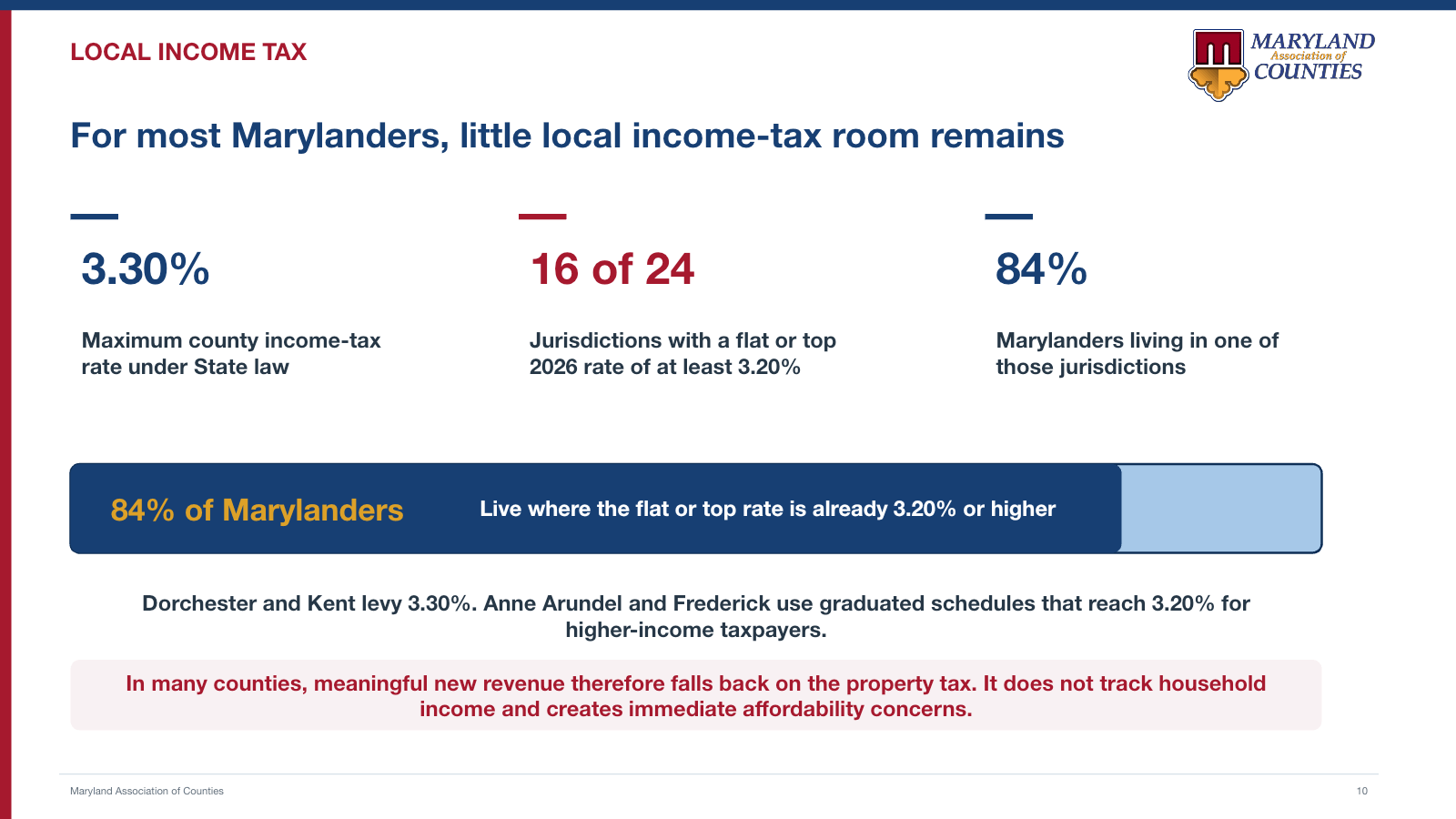
Eighty-four percent of Marylanders live in a county with a flat or top local income tax rate of at least 3.20 percent. State law caps the rate at 3.30 percent.
For most of the state, the local income tax offers little room to generate significant new revenue.
That leaves the property tax as the primary local revenue source.
Counties rely on the property tax to fund core local services, pay debt, build schools, maintain roads, and cover local costs that State and federal funding does not fully support. When new financial pressures emerge, county leaders often have few practical ways to raise the revenue needed to respond.
Additional revenue authority gives counties more flexibility. Local elected officials can determine whether another revenue source makes sense for their community, rather than relying almost exclusively on the property tax whenever new costs arise.
Counties Already Fund Well Above State Requirements
MACo also reviewed several areas where counties already contribute more than State formulas require or provide.
Counties appropriated $8.85 billion for public schools in fiscal 2026. That included at least $1.4 billion above the Blueprint’s mandated local share. Fifteen counties funded their school systems more than 2% above the amount required under State law.
Counties also shoulder high costs outside the Blueprint funding formulas, including roughly $1 billion annually for special education and another $500 million for student transportation.
School construction adds another layer. Local school systems submitted more than $747 million in project requests for fiscal 2027. The State’s core school construction program has historically planned around roughly $360 million annually. Counties must cover local shares, borrow additional money, delay projects, or fit the work around other capital needs.
Transportation funding presents a similar problem.
Local governments maintain more than 80 percent of Maryland’s road miles. The State sharply reduced Highway User Revenues during the Great Recession and never restored the former funding balance.
Current law will cut local HUR funding by nearly $100 million in fiscal 2028.

Over the past decade and a half, Baltimore City alone has lost nearly $1 billion in transportation funding compared with historic HUR levels.
The work remains the same regardless of the funding. Roads require maintenance, bridges require repairs, equipment requires replacement, and safety projects cannot wait.
Most people assume the gas tax they pay at the pump maintains local roads. Increasingly, it is the local property tax. As HUR has declined, counties and Baltimore City have shifted more transportation costs onto local taxpayers to keep the system functioning.
Those costs help explain why counties remain concerned about State cost shifts. Giving counties more revenue options cannot serve as a reason for the State to reduce its own commitments.
Members Asked for More Information
Chaired by Comptroller Brooke Lierman, the Task Force spent its first meeting identifying the information members want before weighing potential recommendations. Rather than debating specific options, the discussion focused on the data needed to understand local revenue challenges and the options available to local governments.
Members asked the Comptroller’s Office to explore whether county-level sales tax data could be produced. Lierman explained that current sales tax returns generally do not identify where individual sales occur when businesses operate in multiple locations, meaning Maryland would need changes to its reporting systems, tax forms, and filing requirements to generate reliable local data.
Members also requested historical county property tax rates and additional information on State policy decisions that continue to shape local budgets, including HUR cuts and teacher pension cost shifts.
Howard County Council Member Christiana Rigby and Montgomery County Chief Administrative Officer Rich Madaleno serve as MACo’s representatives on the Task Force.
MACo President M.C. Keegan-Ayer closed the county presentation with a simple message: “Counties need a menu, not a mandate.”
Some counties may never use additional revenue authority. Others may conclude another revenue source better fits local priorities than relying almost exclusively on the property tax. In every case, the decision would remain with local elected officials, accountable to the residents they serve.
The Task Force will continue meeting through the fall and must submit its findings and recommendations by December 1, 2026.
Stay tuned to Conduit Street for more information.

