
Update: December 22, 2o24
Congress has passed the American Relief Act, 2025, a comprehensive funding bill that prevents a government shutdown and addresses a range of priorities.
This new legislation, signed into law by the President, extends federal funding through March 14, 2025, and secures significant resources for disaster recovery, infrastructure, public health, and economic resilience.
The bill, among other provisions, provides full federal funding to replace the Francis Scott Key Bridge, authorizes the transfer of RFK Stadium to Washington, DC, transfers the DC National Guard’s 121st Fighter Squadron, which flies F-16 aircraft, to the 175th Wing of the Maryland Air National Guard, and allocates approximately $100 billion for natural disaster recovery efforts.
With the federal government approaching another possible shutdown, Congress remains at an impasse over spending priorities, leaving Maryland’s federal workforce and economy particularly vulnerable to the potential fallout.
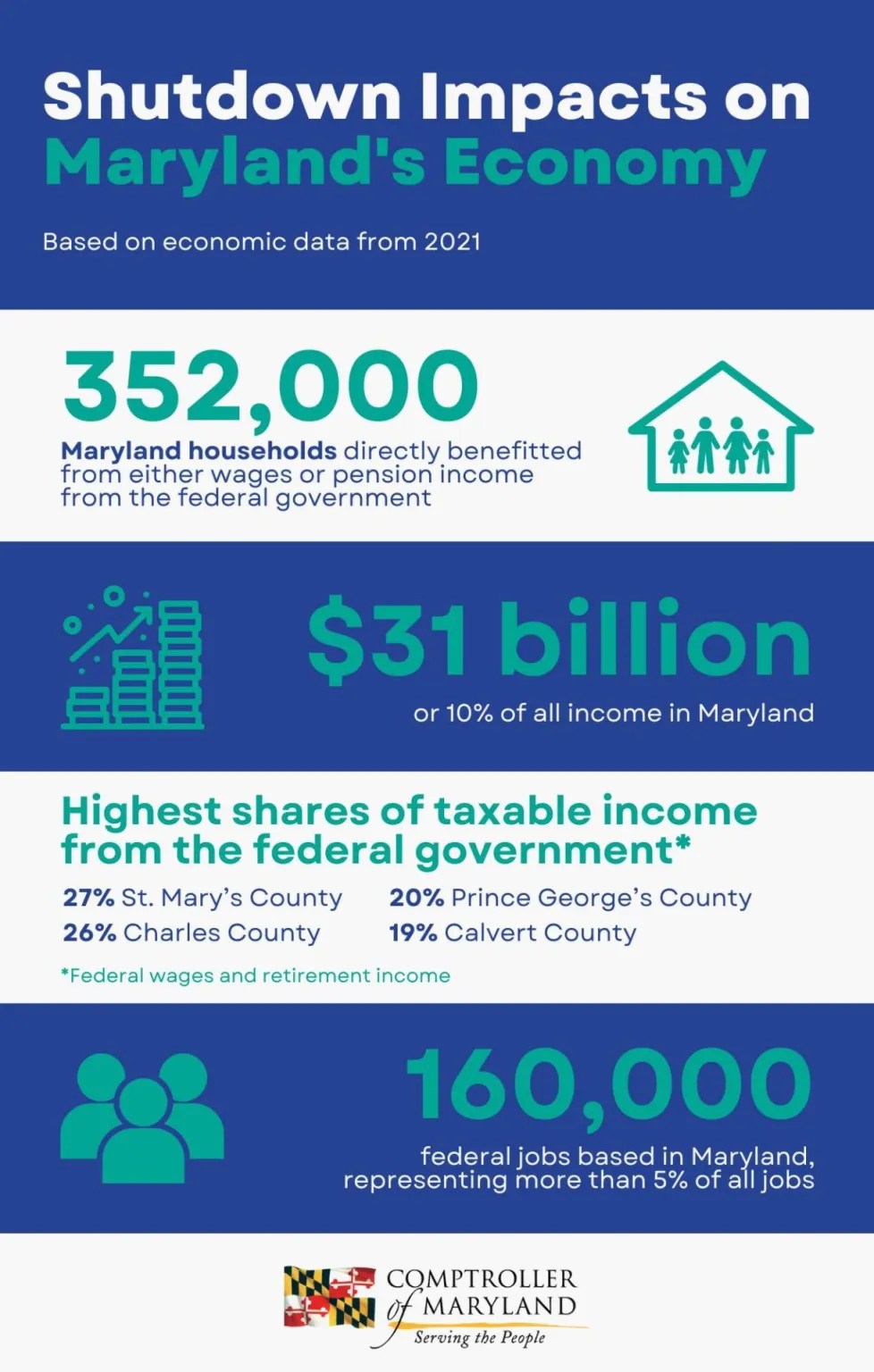
As the December 21 deadline approaches, Maryland — home to over 160,000 federal jobs, thousands of contractors, and numerous businesses reliant on federal operations — faces significant consequences if lawmakers fail to secure government funding.
What’s Causing the Stalemate in Congress?
 Federal funding expires on December 21, when the current stopgap funding measure runs out. Congress has made limited progress on passing appropriations bills for fiscal 2025, with the House passing 5 of the required 12 bills and the Senate passing none.
No bills have been agreed upon by both chambers or signed into law, leaving most federal departments without approved funding for fiscal 2025.
As previously reported on Conduit Street, House Speaker Mike Johnson introduced a continuing resolution to extend funding through March 2025. The agreement included provisions to provide full federal funding for replacing the collapsed Francis Scott Key Bridge, a vital transportation link connecting Baltimore City, Baltimore County, and Anne Arundel County.
However, the proposal collapsed after opposition from key figures, including President-elect Donald Trump. Critics argued that the resolution included provisions seen as concessions to Democrats, such as funding for disaster relief and infrastructure, prompting divisions within the Republican Party.
With limited time, Congress has no clear path forward to avoid a shutdown.
Why Maryland Is Particularly Vulnerable
Maryland, home to over 160,000 federal employees and tens of thousands of contractors, faces outsized consequences from federal funding lapses. A shutdown would result in unpaid wages, reduced state and local tax revenue, and economic strain on businesses reliant on federal operations.
A report from the Maryland Comptroller shows that one in nine Maryland taxpayers is either a federal employee or retiree, with these workers earning over $33 billion annually.
A partial shutdown occurs when Congress passes some appropriations bills, allowing certain agencies and departments to remain funded and operational while those without approved funding must shut down.
On the other hand, a full shutdown occurs when no appropriations bills are enacted by the deadline, causing the closure of nearly all non-essential government operations across all departments.
Regardless of the type of shutdown, essential workers must continue working without immediate pay. In addition, furloughs affect non-essential federal workers during partial and complete government shutdowns.
In a partial shutdown, agencies and departments without funding furlough their employees while other agencies continue operating as usual. In a full shutdown, nearly all non-essential government employees stop working because departments lack the necessary appropriations to stay operational.
Though furloughed workers typically receive back pay after the government reopens, many families cannot afford to go without a paycheck for weeks or months. Federal contractors, however, rarely receive retroactive pay, meaning many Marylanders would lose income permanently.
As previously reported on Conduit Street, approximately 172,000 Marylanders were directly affected by the 2018-2019 partial government shutdown. They missed $778 million in wages, resulting in $57.5 million less in state and local income tax withholding and $2.1 million less in sales tax collections.
In addition, a 2019 US Senate report found that the three government shutdowns in 2013, 2018, and 2019 cost taxpayers nearly $4 billion.
Since Congress has yet to pass any appropriations bills this time, a full shutdown could be even more devastating.
What’s at Stake Now?
With time running out, the likelihood of avoiding a partial or full shutdown continues to shrink, underscoring a more profound failure in the federal budget process.
Lawmakers remain gridlocked over spending levels and policy priorities, creating instability that disrupts effective governance and hinders long-term planning for essential programs and services.
Even if passed, a continuing resolution offers only a reprieve. It highlights the chronic dysfunction in the federal budget system, where failing to pass full-year appropriations on time delays critical funding decisions and forces reliance on short-term fixes, perpetuating uncertainty and undermining fiscal stability.
The prevailing uncertainty is a cause for concern in Maryland. Should Congress fail to act, businesses and residents dependent on federal employment will confront significant financial instability.
While Maryland’s Federal Shutdown Paycheck Protection Act offers some relief by ensuring unemployment benefits or no-interest loans for essential federal employees, it is a stopgap at best. The economic repercussions could ripple across the state’s economy, affecting not just federal workers but also the broader workforce and tax revenue streams.
Looking Ahead
If the House passes a funding measure, it must still pass the US Senate and gain approval from the President to prevent or end the shutdown.
Whether lawmakers can reach an agreement or the government faces another shutdown, the outcome will significantly affect federal workers, contractors, and Maryland’s economy. As the December 21 deadline draws near, uncertainty continues to grow, and the consequences of inaction become increasingly severe.
Stay tuned to Conduit Street for more information.

