
This week, the Department of Legislative Services (DLS) presented its annual fiscal briefing to the General Assembly budget committees. The briefing detailed the governor’s proposed fiscal 2026 operating and capital budgets, aid to local governments, and Maryland’s economic and revenue outlook.
As previously reported on Conduit Street, Governor Wes Moore’s $67.3 billion fiscal 2026 spending plan, which the administration describes as fiscally responsible, blends fiscal responsibility with targeted investments in education, public safety, and workforce development alongside substantial tax reforms and funding shifts.
This plan presents opportunities and challenges for counties, pairing increased funding for critical services with new cost burdens and funding uncertainties.
Quick Look at the Fiscal 2026 Budget
Governor Wes Moore’s proposed $67.3 billion budget addresses fiscal challenges while maintaining investments in key priorities like education, transportation, and public safety.
- General Fund Balance: The budget leaves a $112 million balance at the end of fiscal 2026.
- Rainy Day Fund: The Fund remains at $2.4 billion (9.4 percent of general fund revenues).
- Structural Deficit: Ongoing spending exceeds revenues by $186 million, falling short of the Spending Affordability Committee’s (SAC) goal of eliminating the projected $2.5 billion structural deficit.
The General Assembly traditionally meets the SAC target, meaning lawmakers must close this $186 million gap to adhere to their fiscal guidelines. Resolving the discrepancy could involve a combination of spending cuts or revenue adjustments to ensure compliance.
“The General Assembly has met its SAC goals all but one of the last 40-plus years,” said David Romans, fiscal and policy analysis coordinator at the Maryland Department of Legislative Services. “So, to do that, you’ll have to find additional long-term cuts and/or additional revenues to make up for that $186 million.”

General fund spending in fiscal 2026 declines as the budget incorporates cost-saving measures and accounts for $268 million allocated in fiscal 2025 to cover fiscal 2024 costs that could not be absorbed in that year’s budget. The proposed Budget Reconciliation and Financing Act (BRFA) includes mandate reductions that generate $939 million in savings for fiscal 2026.
Federal spending decreases in fiscal 2026, driven by lower federal Medicaid claims resulting from fiscal 2025 payments on fiscal 2024 obligations. In contrast, special fund spending sees significant growth, including a $543 million increase in the Blueprint for Maryland’s Future Fund for education, a $343 million boost in transportation spending that includes $90 million for the State Climate Pollution Reduction Plan, and more than $160 million in higher education spending supported by tuition, fees, and federal grants.
The governor’s spending plan also reduces Disparity Grants for counties with the greatest need, introduces additional cuts to targeted aid programs, and relies heavily on temporary funding sources, creating uncertainty.
The accompanying BRFA compounds these issues by forcing county governments to shoulder nearly all property assessment costs, phasing out State support for Enterprise Zone tax credits, and shifting more pension burdens onto counties.
These BRFA provisions fundamentally disrupt the balance of State and local fiscal responsibilities, placing considerable pressure on counties already managing rising demands for essential services.

Structural Outlook
As previously reported on Conduit Street, in December 2024, DLS projected a $396 million cash shortfall for fiscal 2025 and a nearly $3 billion deficit for fiscal 2026, assuming the Rainy Day Fund maintained a 10 percent balance of general fund revenues.
The governor’s budget plan closes these immediate gaps by reducing spending, enhancing revenue, transferring funds, shifting costs to local governments, and reducing the Rainy Day Fund balance.
However, the structural deficit remains a significant concern, with projections indicating it will grow to $3.4 billion by fiscal 2030. The primary driver is the cost of K-12 education enhancements under the Blueprint for Maryland’s Future, which continue to outpace available revenues.
While DLS anticipates lower Medicaid spending in future years, education spending remains the most significant fiscal pressure, underscoring the need for long-term solutions beyond the current plan.
Budget Includes Enhancements
The budget plan includes $187 million in funding for enhancements not anticipated in the DLS forecast. Over two-thirds of this funding is allocated to stimulating economic growth, with approximately $55 million allocated to capital projects.

Potential Legislative Issues
Federal Policy and Funding Uncertainty
Changes in federal policies pose significant risks to Maryland’s economy and fiscal outlook. About 8 percent of Maryland taxpayers received federal W-2s in 2021, and the fiscal 2026 budget depends on over $20 billion in federal funds. Cuts to federal aid or employment programs could destabilize Maryland’s economy and budget.
Revenue Volatility
The Governor’s Budget Reconciliation and Financing Act (BRFA) increases reliance on volatile revenue sources like capital gains taxes. Proposed income tax changes suspend the revenue volatility set aside, heightening the risk of fiscal instability due to market fluctuations.
Child Victims Act of 2023
The Child Victims Act creates an immediate and significant fiscal challenge. The law permits survivors of alleged sexual abuse to file civil lawsuits against the State without a statute of limitations, with liability capped at $890,000 per claim. Approximately 3,500 claims are active, though the total liability remains uncertain.
Settlement negotiations advance quickly, yet the governor’s fiscal 2025 and out-year budgets do not include funding for these payments. The General Assembly must allocate resources promptly, as substantial payments could be required before the session ends to address fiscal 2025 and 2026 settlements. This issue poses a significant financial burden for the State of Maryland.
What Does It Mean for Counties?
Local Government Aid
Note: The State budget often highlights “local aid” as a significant investment in Maryland’s counties. However, most of this funding is earmarked for public education and provides little to no direct support for county operations or services.
The fiscal 2026 budget provides $11.4 billion in aid to local governments, an increase of $602 million (5.6 percent) over fiscal 2025, including contingent reductions.
The primary increases include $554.3 million for K-12 education aid, $117 million for local health department funding (a 5.2 percent increase), and $22.5 million for aid for community colleges (a 4.7 percent increase).
Education
The governor’s spending plan allocates $8.9 billion for K-12 education. While cost-saving measures like pausing collaborative time and community schools reduce expenses, additional obligations—such as $25 million in special education costs and nearly $93 million in retirement costs—create new fiscal pressures for county budgets, which bear significant responsibility for school funding in Maryland.
State aid details by category include:
- Foundation Program: The most significant local aid program distributes funding based on public school enrollment and taxable wealth. The budget reflects a contingent reduction to delay collaborative time, generating savings for the State and counties.
- Special Education: Approximately $551 million supports the education of students with specialized needs. However, the BRFA reduces the State’s share of nonpublic special education placement costs from 70 to 60 percent, shifting $25 million to local school systems. The counties absorb the impact.
- Compensatory Education: This program allocates $1.5 billion based on enrollment and student needs, targeting those eligible for free and reduced-price meals.
- Student Transportation: Provides $357 million, including grants for transporting students with special needs.
- Other Education Aid: The program allocates $544.7 million for students with limited English proficiency, $492.6 million for high-poverty schools, $172.6 million for phased-in universal prekindergarten, and $66.7 million for the Guaranteed Tax Base Program.
Significant Retirement Costs Shift to Counties
Starting in fiscal 2026, BRFA proposes significant changes to teacher retirement funding. Counties would shoulder an additional $92.9 million in retirement costs, calculated based on local teacher salaries. This shift imposes considerable financial pressure on county budgets, potentially leading to reduced services or increased taxes to manage the added burden.
Supplemental Retirement Grants Phased Out
At the same time, the BRFA proposes to reduce supplemental retirement grants under Aid to Civil Divisions by 50 percent in fiscal 2026 and eliminate the program by fiscal 2027.
The State pledged these grants in 2012 when it shifted a significant portion of teacher pension costs to county governments. Before this change, the State fully funded teacher pension contributions. In fiscal 2025, counties relied on these grants to offset pension costs, but the phase-out leaves counties to shoulder the entire burden.
Community Colleges
The governor’s budget provides $500.6 million for Maryland’s community colleges, reflecting a $22.5 million increase over fiscal 2025. This funding includes $11.8 million for small colleges, $6 million for out-of-county and out-of-state student programs, and $4.7 million for English for Speakers of Other Languages (ESOL) programs.
While the State funds pension and retirement benefits for community college employees, totaling $57.8 million in fiscal 2026, the BRFA proposes shifting approximately $5 million of rising retirement costs to counties, adding to the growing fiscal burden.
Transportation
The governor’s fiscal 2026 budget allocates $478.8 million for local transportation aid, a $52.7 million increase (12 percent) over fiscal 2025. This funding includes Highway User Revenues, support for Locally Operated Transit Systems (LOTS), Elderly and Disabled Transportation programs, and Bus Rapid Transit (BRT).
- Highway User Revenues (HUR): The budget provides local governments $445.8 million in HUR, maintaining fiscal 2026 funding stability. However, without further legislative action, counties face a significant funding reduction in fiscal 2028 as the temporary funding levels expire.
- Locally Operated Transit Systems (LOTS): The fiscal 2026 budget increases funding for grants supporting county transit operations.
- Elderly and Disabled Transportation: Counties receive $6 million for transit services catering to elderly and disabled residents, ensuring compliance with federal mandates like paratransit operations.
- Bus Rapid Transit (BRT): The State Lottery Fund provides $27 million annually to support BRT systems. Montgomery County is an eligible jurisdiction and receives at least $20 million, with the remaining funds allocated based on population.
-
State Retail Delivery Fee: The proposed budget includes a new $0.75 retail delivery fee, projected to generate approximately $225 million annually.
Police, Fire, and Public Safety
The governor’s fiscal plan allocates $214.3 million for public safety aid to counties and municipalities, reflecting a $3.1 million increase over fiscal 2025. These funds support police protection, fire, and rescue services, and targeted public safety initiatives.
- Police Protection Aid: Counties and municipalities will receive $121.8 million for police services, including $45.9 million for enhancements beyond the mandated formula.
- Fire, Rescue, and Ambulance Aid: Local governments will receive $16.5 million in grants to support fire, rescue, and ambulance services, including funding for capital improvements and emergency response equipment.
- Targeted Public Safety Grants: The budget provides $75.9 million for programs such as STOP Gun Violence grants, domestic violence unit funding, and police recruitment and retention efforts. It also supports the Maryland Criminal Intelligence Network, aiming to bolster statewide crime prevention initiatives.

Miscellaneous Aid: Disparity Grant Reductions and Local Health Increases
The governor’s fiscal 2026 budget allocates $433.9 million for miscellaneous aid, reflecting a $34.1 million (7.3 percent) decrease from fiscal 2025. This funding supports critical programs, including Local Health Grants, Disparity Grants, and Video Lottery Terminal (VLT) Impact Aid.
Note: Even though local health grants are increasing, Maryland’s outdated funding formula continues to leave local health departments underfunded, creating ongoing fiscal strain amid rising costs and evolving public health challenges.
- Local Health Grants: Allocations increase to $117 million, up $5.8 million (5.2 percent) from fiscal 2025. These grants fund essential preventative health services, including family planning, maternity care, cancer control, and AIDS education.
- Disparity Grants: Funding decreased from $188.5 million in fiscal 2025 to $176.6 million in fiscal 2026, representing an $11.9 million (6.3 percent) reduction. These grants assist counties with lower per capita income tax revenues.
- VLT Impact Aid: Jurisdictions hosting Video Lottery Terminal facilities receive $104.9 million, a slight reduction from fiscal 2025. Major recipients include Prince George’s County and Baltimore City, where these funds remain vital for addressing community impacts.

Income Tax Overhaul
The governor’s fiscal 2026 budget includes significant reforms to Maryland’s income tax system aimed at simplifying calculations, providing relief for taxpayers, and generating revenue. These changes are expected to increase general fund revenue by approximately $820 million in fiscal 2026.
Significant changes include:
- Standard Deduction Increase: Raising the maximum standard deduction to $5,600 for single filers and $11,200 for joint filers, ensuring all households qualify regardless of income.
- Itemized Deductions Eliminated: Simplifying the tax filing process by removing the option to itemize deductions.
- Child Tax Credit Modifications: The previous system, in which households lost benefits once their income exceeded $15,000, will be replaced by gradual phase-outs.
- New Tax Brackets: Adjustments to tax brackets and a 1 percent surcharge on capital gains income exceeding $350,000 for four years.
Corporate and Tax Policy Reform
The governor’s proposed corporate and tax policy reforms aim to simplify Maryland’s tax structure, enhance competitiveness, and align with neighboring states.
Corporate Income Tax Reform
- Lower Corporate Tax Rate: The corporate income tax rate will decrease from 8.25 percent to 7.99 percent, enhancing Maryland’s business climate.
- Water’s Edge Combined Reporting: This reform broadens the corporate tax base by treating all related U.S. business entities as a single entity for Maryland tax purposes. It ensures corporations with significant Maryland operations pay taxes on income earned in the state.
Tax Policy Adjustments
- Inheritance and Estate Tax Changes: The proposal eliminates Maryland’s inheritance tax, offset by reducing the estate tax exemption from $5 million to $2 million.
- Gaming Taxes:
- Sports wagering tax increases from 15 percent to 30 percent.
- Table games tax increases from 20 percent to 25 percent.
- Cannabis Tax Increase: Starting in fiscal year 2027, the State will increase the adult-use cannabis tax rate from 9 to 15 percent.
Enterprise Zone (EZ) Tax Credits
The BRFA proposes phasing out state funding for Enterprise Zone tax credits by June 30, 2025. This change impacts counties that rely on these credits to incentivize economic development in distressed areas.
SDAT Cost Shift: A Misguided Burden on Counties
The governor’s budget revives a problematic proposal to shift the State Department of Assessments and Taxation (SDAT) costs nearly entirely to county governments. Counties reimburse the State for 50 percent of SDAT’s operating costs.
1/ #Maryland’s property assessment system works because it is centralized, impartial, and uniform—promoting fairness and consistency across the State.
However, the proposed budget trades its integrity for negligible budget savings. 🧵#MDPolitics #MDGA25
— Kevin Kinnally (@KKinnally_MACo) January 17, 2025
The BRFA seeks to increase this share to 90 percent, imposing an additional $21 million burden on counties. This cost shift is unnecessary and harmful for several reasons:
- Undermines Objectivity: Shifting 90 percent of assessment costs onto counties risks compromising the objectivity of property assessments. A system primarily funded and managed by the State ensures unbiased valuations and maintains taxpayer confidence.
- Creates Fiscal Inequities: While counties benefit from the revenue generated by SDAT’s assessments, the State and its residents equally rely on uniform procedures, consistent valuations, and streamlined appeals. Forcing counties to shoulder the bulk of these costs disregards the shared benefits of SDAT’s work.
- Jeopardizes Budgetary Accountability: DLS has repeatedly cautioned against increasing counties’ cost share for SDAT. By transferring this financial burden, the State reduces its incentive to manage SDAT’s budget and ensure operational efficiency.
Counties face significant fiscal challenges, including funding education, transportation, public safety, and other essential services. Absorbing an additional $21 million for SDAT operations would divert resources from these critical priorities, leaving counties struggling to meet local needs.
The General Assembly has repeatedly rejected this proposal in prior legislative sessions for good reason. MACo has consistently opposed this cost shift and successfully struck similar attempts from the State’s fiscal plans in 2017, 2018, 2020, and 2021.
School Construction
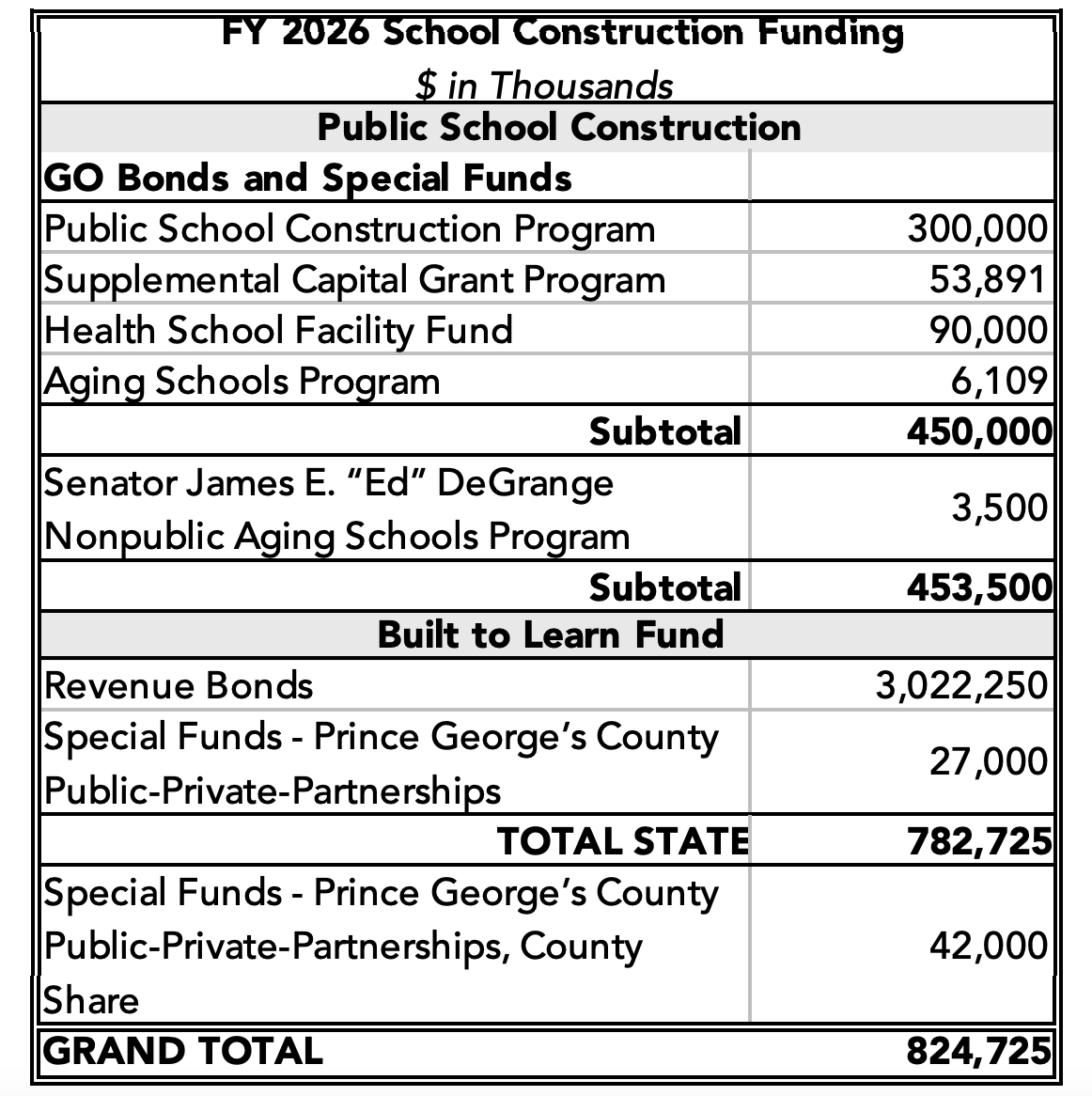
The governor’s fiscal 2026 capital budget includes $824.7 million for school construction, a $57.4 million increase over previous plans. This funding meets the legislative intent to allocate $450 million annually for public school construction programs.
Significant allocations include:
- $9.1 million from the Fiscal Responsibility Fund to support school construction projects statewide.
- $53.9 million for the Supplemental Capital Grant Program, aimed at fast-growing counties struggling with overcrowding.
- $90 million for the Healthy School Facility Fund to address health-related building improvements.
- $6.1 million for the Aging Schools Program to upgrade facilities in older buildings.
The budget also continues to support the $1.7 billion Built to Learn Fund, with $302.2 million in revenue bonds dedicated to renovation and construction projects, funded through casino revenues from the Education Trust Fund. Additionally, $27 million annually from the Built to Learn Fund supports critical school projects in Prince George’s County through public-private partnerships.
What’s Ahead?
The governor’s fiscal 2026 plan is subject to General Assembly approval. There, lawmakers will review and adjust it while weighing its impacts on counties and communities across Maryland.
By custom, the House and Senate move the budget bill in alternate years – the House moves the budget in odd-numbered years, and the Senate moves the budget in even-numbered years. For example, the budget bill will start in the House this year.
As the budget moves to the General Assembly for review, MACo will advocate for a more balanced approach that supports essential services without overburdening local governments.
Stay tuned to Conduit Street for more information.
Useful Links
Proposed Budget Documents (fiscal 2026):
Proposed Operating Budget Detail by Agency
Previous Conduit Street Coverage: Governor’s Fiscal 2026 Budget: Navigating County Effects
Previous Conduit Street Coverage: Counties Confront Fiscal Challenges Amid Sluggish Revenue Growth
Previous Conduit Street Coverage: 2025 Issue Preview: Maryland’s Budget Crossroads